Cherokee County Dog Registration Information
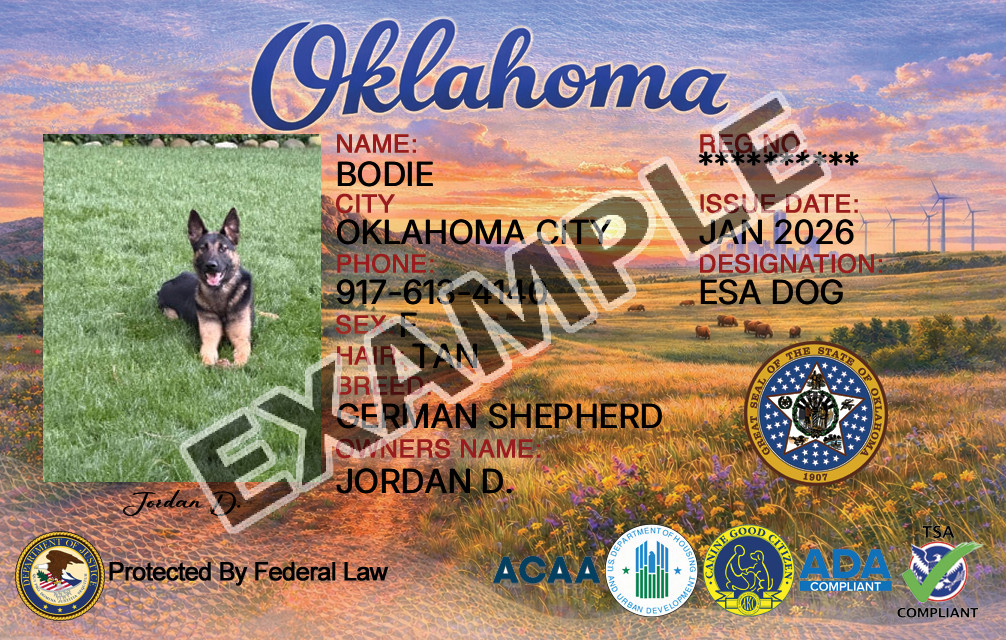
Service Dogs and Emotional Support Animals in Cherokee, Oklahoma
Where Do I Register My Dog in Cherokee County, Oklahoma for My Service Dog or Emotional Support Dog?
If you’re asking “where do I register my dog in Cherokee County, Oklahoma for my service dog or emotional support dog,” the answer usually depends on where you live inside the county (city limits versus unincorporated areas). In many cases, the local government entity that handles animal control and pet licensing is the correct place to start for a dog license in Cherokee County, Oklahoma. Separately, it’s important to know that service dogs and emotional support animals (ESAs) are not registered through one universal federal government registry. Instead, you may need (1) a local pet license/tag (if required where you live) and (2) the appropriate documentation or training status depending on whether the animal is a service dog or an ESA.
- Local dog licensing is typically handled by a city animal control/shelter or other local office (and often requires proof of current rabies vaccination).
- Service dogs are recognized based on training to perform tasks for a person with a disability—not because they are “registered” in a national database.
- Emotional support animals (ESAs) are not service dogs and generally rely on a letter from a licensed healthcare professional for specific housing-related situations.
Where to Register or License Your Dog in Cherokee County, Oklahoma
The offices below are official local government contacts that may help with where to register a dog in Cherokee County, Oklahoma, including pet licensing within certain city limits and animal control services. If you live outside city limits, your requirements may differ, and the county-level offices can help direct you to the correct agency.
City of Tahlequah Animal Control (Tahlequah Animal Shelter)
This office provides animal control within Tahlequah city limits and references requirements such as proof of rabies vaccination and a city pet license in certain situations. If you are within Tahlequah city limits, this is often the most direct contact for pet licensing questions and related animal services.
Cherokee County Sheriff’s Office (County Government Contact for Unincorporated Areas)
If you live outside municipal city limits in Cherokee County, Oklahoma, you may need guidance on which agency handles animal services and whether any county-level licensing applies in your area. The Sheriff’s Office is a county contact that may be able to route you to the appropriate local animal services office.
Cherokee County Clerk (General County Government Contact)
If you are unsure which department handles an animal control dog license in Cherokee County, Oklahoma for your specific address, the County Clerk’s office is a reliable county government contact point to help confirm the correct local office (especially when rules vary by municipality).
Overview of Dog Licensing in Cherokee County, Oklahoma
A dog license in Cherokee County, Oklahoma is usually a local registration/tag requirement established by a municipality (city/town) and/or the local animal control authority. In many communities, licensing serves practical purposes such as:
- Helping animal control and shelters quickly identify an owner if a dog is found loose
- Promoting rabies vaccination compliance to protect public health
- Supporting animal services operations (varies by municipality)
When people say “register my dog,” they often mean “get the local license tag.” This is different from service dog or emotional support animal status. A local license is about public health and animal control identification; service dog/ESA status is about specific legal rights and responsibilities.
What You Need Before Registering a Dog
While dog licensing requirements in Cherokee County, Oklahoma may vary by city, many local licensing processes ask for some combination of the items below. If your dog is being licensed through a city office, expect to show current rabies vaccination proof.
Common items requested
- Proof of current rabies vaccination (often a rabies certificate from a veterinarian)
- Your contact information (name, phone number, address)
- Dog details (name, breed, color/markings, sex, and sometimes microchip number if applicable)
- Proof of spay/neuter (if your city offers a reduced fee or different license class)
- Payment for the license/tag fee (amount and acceptable methods can vary)
Steps to Register or License a Dog in Cherokee County, Oklahoma
The steps below describe a typical path for where to register a dog in Cherokee County, Oklahoma. Because Cherokee County has multiple jurisdictions, you should start by confirming which office serves your address.
-
Confirm your jurisdiction (city limits vs. unincorporated county).
Your licensing office may be a city animal control/shelter (for city residents) or another local authority. If unsure, call a county government contact to confirm the correct office.
-
Gather rabies vaccination proof and basic dog/owner information.
Many offices require current rabies vaccination documentation to issue or renew a dog license tag.
-
Ask what licensing options apply to your dog.
Some locations have annual tags, different fees for altered vs. unaltered dogs, or additional rules for multiple dogs.
-
Submit the application (if required) and pay the fee.
Ask how you will receive your tag and whether it must be attached to the dog’s collar when in public.
-
Keep records handy.
Save a copy of your rabies certificate and license receipt/tag number for renewals and in case you need to prove compliance.
If your question is specifically “where do I register my dog in Cherokee County, Oklahoma for my service dog or emotional support dog,” the practical approach is: (1) follow local dog licensing rules for your city/county area, and (2) understand that service dog/ESA status is handled through legal definitions and documentation/training—rather than a universal registry.
Dog License vs. Service Dog vs. Emotional Support Animal (Comparison)
Many residents are surprised to learn these are three different concepts. The table below explains the difference between a local pet license and disability-related classifications.
| Category | What it is | Typical requirements | Where it’s handled |
|---|---|---|---|
| Dog License | A local registration/tag used for animal control identification and public health compliance. | Often requires proof of rabies vaccination; may require owner/dog details and a fee; rules vary by municipality. | Usually a city animal control/shelter or local licensing office; requirements can vary inside Cherokee County by city/town. |
| Service Dog | A dog individually trained to do work or perform tasks for a person with a disability. | Task training related to the handler’s disability; must be under control; generally no universal federal registration required. | Legal status is defined by applicable disability laws; local licensing may still apply like any other dog. |
| Emotional Support Animal (ESA) | An animal that provides emotional support that alleviates one or more effects of a person’s disability (commonly relevant in housing contexts). | Typically supported by documentation from a licensed healthcare professional for certain housing-related accommodations; not the same as service-dog task training. | Often addressed in housing accommodation processes; local dog licensing may still apply like any other dog. |
Service Dog Laws in Cherokee County, Oklahoma
Service dog rights are based on the dog’s function and training—not on a paid “registration.” A service dog is generally a dog trained to perform specific tasks for an individual with a disability. Examples of service dog tasks can include guiding, alerting to sounds, retrieving items, interrupting harmful behaviors, or alerting to medical events (depending on the person’s disability-related needs).
How service dog status relates to local licensing
- Service dog status is separate from a dog license. A local license/tag is a local animal control matter, while service dog status is a disability-law matter.
- Rabies vaccination and public health rules still apply. Most communities still expect service dogs to be vaccinated and compliant with local animal regulations.
- No single universal federal registry exists. If someone tells you there is one required federal registry for service dogs, that is not how service dog recognition typically works.
If you need help understanding your local licensing obligations while living with a service dog, start with the official office serving your address (for example, city animal control if you’re in city limits), and ask what is required for any dog kept in that jurisdiction.
Emotional Support Animal Rules in Cherokee County, Oklahoma
An emotional support animal (ESA) is not the same as a service dog. ESAs generally do not have the same public-access status as service dogs. ESA documentation is most commonly used when requesting certain housing accommodations. Because rules and processes can depend on the housing provider and the situation, the practical steps often include gathering appropriate documentation and understanding your responsibilities as an animal owner.
How ESA status relates to local dog registration
- ESA status does not replace local licensing. If your municipality requires a pet license, you would generally still license your dog like any other dog.
- Expect vaccination documentation. Proof of rabies vaccination is a common requirement for licensing and for many pet-related administrative processes.
- ESAs are not validated by a universal registry. There isn’t one official nationwide ESA registry used by government agencies to “register” ESAs.
Frequently Asked Questions
Do I have to register a service dog in Cherokee County, Oklahoma?
You generally do not “register” a service dog in a single national system to make it a service dog. However, local rules for rabies vaccination and any applicable local pet licensing/tag requirements may still apply depending on where you live in Cherokee County, Oklahoma.
Where do I get a dog license in Cherokee County, Oklahoma?
It depends on your jurisdiction. If you live within Tahlequah city limits, the City of Tahlequah Animal Control/Animal Shelter is a key official contact for animal services and pet license questions. If you live outside municipal limits, contact a county office to confirm which local agency handles licensing or animal services for your area.
Is proof of rabies vaccination required to license my dog?
Many local licensing systems require proof of current rabies vaccination before issuing a tag. If you are trying to meet dog licensing requirements in Cherokee County, Oklahoma, have your rabies certificate ready and ask the relevant office what documentation they accept.
I live in Cherokee County but outside Tahlequah city limits—who should I call?
Start by calling a county government contact (such as the Cherokee County Sheriff’s Office or County Clerk) and ask which agency handles animal services and any licensing requirements for your specific address in the unincorporated area. Requirements can differ by municipality.
Do emotional support animals need a special license tag?
ESAs typically follow the same local pet licensing process as other dogs if your jurisdiction requires licensing. ESA status is generally a separate issue tied to certain accommodation requests (often housing-related), not a replacement for a local dog license/tag.
If my dog is already microchipped, do I still need a license?
A microchip is an identification tool, while a dog license is a local compliance and identification requirement (when applicable). If your city or local authority requires licensing, a microchip usually does not replace the requirement to obtain a tag.
Local Summary for Cherokee County, Oklahoma
To address the core question—where do I register my dog in Cherokee County, Oklahoma for my service dog or emotional support dog—start by identifying your local jurisdiction and contacting the official animal services/licensing office that serves your address. For Tahlequah residents, the City of Tahlequah Animal Control is a key official point of contact. For residents outside municipal limits, use county government contacts to confirm which local authority administers any animal services or licensing requirements in your area. In all cases, remember that service dog and emotional support animal status are not granted by a single universal federal registry, and local rabies vaccination and licensing rules may still apply.
Local laws, fees, office locations, and contact details can change. Residents should verify the most current information with their local animal services or licensing office in Cherokee County, Oklahoma.
Register A Dog In Other Oklahoma Counties
Select your county below to get started with your dog’s ID card. Requirements and license designs may vary by county, so choose your location to see the correct options and complete your pup’s registration.
- Adair Dog License Cards
- Alfalfa Dog License Cards
- Atoka Dog License Cards
- Beaver Dog License Cards
- Beckham Dog License Cards
- Blaine Dog License Cards
- Bryan Dog License Cards
- Caddo Dog License Cards
- Canadian Dog License Cards
- Carter Dog License Cards
- Choctaw Dog License Cards
- Cimarron Dog License Cards
- Cleveland Dog License Cards
- Coal Dog License Cards
- Comanche Dog License Cards
- Cotton Dog License Cards
- Craig Dog License Cards
- Creek Dog License Cards
- Custer Dog License Cards
- Delaware Dog License Cards
- Dewey Dog License Cards
- Ellis Dog License Cards
- Garfield Dog License Cards
- Garvin Dog License Cards
- Grady Dog License Cards
- Grant Dog License Cards
- Greer Dog License Cards
- Harmon Dog License Cards
- Harper Dog License Cards
- Haskell Dog License Cards
- Hughes Dog License Cards
- Jackson Dog License Cards
- Jefferson Dog License Cards
- Johnston Dog License Cards
- Kay Dog License Cards
- Kingfisher Dog License Cards
- Kiowa Dog License Cards
- Latimer Dog License Cards
- LeFlore Dog License Cards
- Lincoln Dog License Cards
- Logan Dog License Cards
- Love Dog License Cards
- Major Dog License Cards
- Marshall Dog License Cards
- Mayes Dog License Cards
- McClain Dog License Cards
- McCurtain Dog License Cards
- McIntosh Dog License Cards
- Murray Dog License Cards
- Muskogee Dog License Cards
- Noble Dog License Cards
- Nowata Dog License Cards
- Okfuskee Dog License Cards
- Oklahoma Dog License Cards
- Okmulgee Dog License Cards
- Osage Dog License Cards
- Ottawa Dog License Cards
- Pawnee Dog License Cards
- Payne Dog License Cards
- Pittsburg Dog License Cards
- Pontotoc Dog License Cards
- Pottawatomie Dog License Cards
- Pushmataha Dog License Cards
- Roger Mills Dog License Cards
- Rogers Dog License Cards
- Seminole Dog License Cards
- Sequoyah Dog License Cards
- Stephens Dog License Cards
- Texas Dog License Cards
- Tillman Dog License Cards
- Tulsa Dog License Cards
- Wagoner Dog License Cards
- Washington Dog License Cards
- Washita Dog License Cards
- Woods Dog License Cards
- Woodward Dog License Cards
